About Me

My photo
This site is for educational purposes only, and to built a reptile community for all the reptile lovers out there. I also do reptile rescue, reptile sitting (short and long term), and reptile extraction, lol but it happens. I'm in San Diego, and if you need to give up your reptile, for whatever reason, give me a call at 619-971-6672, and my name is Cisko.

Tuesday, December 8, 2009

corn snake


Here's a corn snake for you to see.

Bearded dragon going up the steps, to bed, goodnight.


Maya our bearded dragon here at mclovins creatures and rescue is going to bed now, she's gone. Please visit also http://ireptilerescue.blogspot.com to see more excitting reptiles.

Monday, December 7, 2009

albino honduran milksnake


ALBINO HONDURAN MILK SNAKES - A unique combination of red, tangerine, and yellow bands are represented in this variety. Overall triad count usually numbers 20 to 24. We consider the Albino Honduran the best possible discovery of an albino genetic trait in the Milk Snake specie group. The attraction of large size and intense color combinations have moved the Honduran Milk Snakes into a class by themselves. Through selective breeding, a highly refined albino tangerine Honduran may well become the most popular albino tri-color. The combining of this albino gene with the other Honduran Milk varieties provides a multitude of present and future possibilities. This strain originates from heterozygous albino wild caught imported adults bred in East Germany in the late 1980"s. We are developing the refined appearance of the albino and heterozygous albino strains through multi-generational outbreeding to extreme quality tangerine phase Hondurans or the "Super Hypo" strain. We will also be producing double heterozygous specimens by breeding the albino trait to the anerythristic trait leading to a "Snow" Honduran and to the striped/vanishing pattern trait leading to a striped or vanishing pattern albino.

Maya the bearded dragon


This is Maya, mclovins creatures and rescue favorite beardie.

tokay gecko

this is the famouse tokay gecko here at mclovins creatures and rescue.

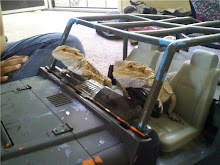
bearded dragons on the steps

Check out my bearded dragons just hanging out on the stairs.

pink to tarantula


This is the pink toe tarantula here at mclovins creatures and rescue. if interested in adopting this pink toe tarantula, send me an e-mail. you can also check out my other blog at http://ireptilerescue.blogspot.com Drop me a line if you want to adopt this pink toe tarantula.

bearded dragons on the stairs.


Check out the bearded dragons on the stairs, just chillin here at mclovins creatures and rescue.

Saturday, December 5, 2009

Maya the bearded dragon

This is Maya, Our female bearded dragon, she is so lovable.

Wednesday, December 2, 2009

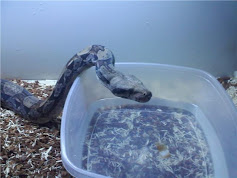
Brazillian Rainbow Boa

Brazilian Rainbow Boa
TaxonomyOrder: Squamata Family: Boidae Genus/species: Epicrates cenchria cenchria
DescriptionThe Brazilian rainbow boa is one of about 12 named subspecies of rainbow boa. There is, however, much debate about the number of subspecies.
The Brazilian rainbow boa is a round-bodied terrestrial boa of medium build. The head is not particularly large, but it is distinctly wider than the neck. It is soft-skinned with great iridescence in its skin. Brazilian rainbow boas are brown or reddish brown. There are three parallel black stripes on the top of the head and large black rings down the back that give the appearance of dorsal blotches. The round lateral blotches are black with an orange or reddish crescent across the top. There is a great deal of variation in color and marking among individuals of this species. Many consider this one of the world’s most beautiful snakes.
Adult males have substantially larger spurs along the side of the vent and also have noticeably thicker bases of their tails due to the invaginated hemipenes. These boas range from four to six feet (1.2 to 1.8 m) in length.
Distribution and HabitatRainbow boas are widespread throughout much of South America. Brazilian rainbow boas occur in the Amazon Basin, and in coastal Guiana, French Guyana, and Suriname and southern Venezuela. They live in humid woodland forests and can sometimes be found in open savannas.
Diet in the WildIn the wild the diet consist of rodents, birds, and possibly some forms of aquatic life and lizards.
Zoo DietThe boa is fed rats and chicks.
ReproductionSexual maturity is usually reached in the first 2.5 to four years. Males may breed at four feet (1.2 m) and females at 4.5 feet (1.4 m). Gestation lasts about five months. Baby Brazilian rainbows are born live in litters of two to 35. A typical litter contains twelve to 25 babies. The babies are usually 15 to 20 inches (38 to 51 cm) long. Yearlings often grow to four feet (1.2 m) in length, though 36 to 40 inches (91 to 100 cm) is more typical. Females seem to eat more and grow larger than males.
Life SpanThey may live up to 20 years in captivity.
StatusThis snake does not have any special status. Brazilian rainbow boas occur naturally across much of the northern half of South America. They were exported in fair numbers from Suriname during the 1980s and early 1990s. They are now exported in much more limited numbers and most specimens offered for sale today are captive bred.
Fun FactsRainbow boas are so named because of the iridescent sheen imparted by microscopic ridges on their scales, which act like prisms to refract light into rainbows.
Powered By Blogger